Cycling the D-Day Landing Beaches
As you cycle along the Normandy coast, step back in time to 1944 to explore the ruins and memorial sites of the famous D-Day, the Allied landings in France during World War II.
Explore the D-Day beaches by bike, a land steeped in history with diverse landscapes, from lush green hills to spectacular cliffs. Immerse yourself in its rich past, from the D-Day landings on June 6, 1944, to the Battle of Normandy that followed. A memorable cycling experience that combines history, cuisine, and nature.
 Fit
Fit


 Leisure ,
Exploring the D-Day Beaches by Bike: A Journey Through Memory, History, and Stunning Landscapes
Exploring the D-Day beaches by bike means discovering one of the most iconic sites in contemporary history while enjoying the breathtaking landscapes of the Normandy coastline. Amid cliffs, long sandy beaches, small fishing ports, and charming villages, this route offers a unique immersion in the heart of a region where every kilometer tells a story of the Liberation.
On June 6, 1944, the Normandy coast was the scene of the largest amphibious and airborne military operation in history. From the Cotentin Peninsula to the Orne Estuary, tens of thousands of American, British, Canadian, and soldiers of many other nationalities landed to pave the way for the liberation of occupied Europe. The fighting continued for several weeks, leaving an indelible mark on the region.
Today, these peaceful landscapes invite you on a journey through history. Cycling offers the perfect pace to take the time to explore the many historic sites, museums, memorials, and remnants that dot the route. Each stop provides a deeper understanding of the events of D-Day through testimonies, period artifacts, and the stories of the men who took part in this decisive operation.
From the famous beaches of Utah Beach, Omaha Beach, Gold Beach, Juno Beach, and Sword Beach to the impressive military cemeteries, emotion is ever-present. The American Cemetery at Colleville-sur-Mer, overlooking Omaha Beach with its 9,387 perfectly aligned crosses, remains one of Normandy’s most moving places of remembrance.
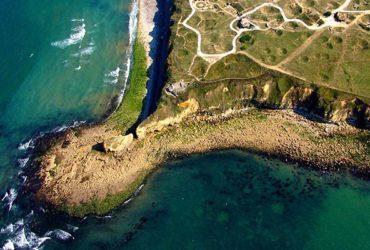
The tours also allow visitors to explore several major sites where the traces of the past are still clearly visible. At Pointe du Hoc, the massive bomb craters, bunkers, and cliffs bear witness to the ferocity of the battles fought by the American Rangers. In Arromanches, the remains of the artificial harbor serve as a reminder of the incredible logistical feat that made it possible to supply the Allied forces after D-Day.
Further east, Pegasus Bridge commemorates one of the first operations of the night of June 5–6, 1944, when British airborne troops captured the bridge to secure the Allies’ advance. In Sainte-Mère-Église, now famous throughout the world, the paratrooper suspended from the church steeple pays tribute to American soldier John Steele and to this episode, which has become one of the symbols of the D-Day landings.
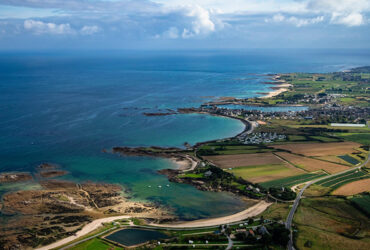
Beyond its exceptional historical richness, this destination also captivates visitors with the diversity of its landscapes. The coastal roads wind past vast beaches, spectacular cliffs, marshes, lush countryside, and charming seaside resorts. The routes are accessible to most cyclists and allow you to fully enjoy the unique atmosphere of this coast steeped in history.
Must-See Sites
- Omaha Beach: the most famous of the D-Day beaches, nicknamed “Bloody Omaha” due to the heavy casualties suffered on June 6, 1944. Don’t miss the American Cemetery at Colleville-sur-Mer, the Omaha Beach Memorial Museum, and the Overlord Museum.
- Utah Beach: Located at the western end of the D-Day beaches, it was one of the sectors where American troops advanced the fastest. The Utah Beach D-Day Museum and the Airborne Museum in Sainte-Mère-Église offer a deeper understanding of this operation.
- Pointe du Hoc: One of Normandy’s most impressive sites, with its cliffs, bunkers, and numerous craters left by Allied bombing.
- Arromanches-les-Bains: famous for the remains of the Mulberry artificial harbor, a true engineering feat that played an essential role in the success of Operation Overlord.
- Juno Beach: the landing beach for Canadian forces, it is home to the Juno Beach Centre, which chronicles Canada’s participation in World War II.
- Sword Beach and Pegasus Bridge: Near Ouistreham, explore the beach where British forces landed, as well as the Pegasus Bridge Museum, which features the original bridge captured on the night before D-Day.
- The Caen Memorial: Considered one of the largest museums dedicated to World War II in Europe, it traces the origins of the conflict, the D-Day landings, the Battle of Normandy, and the peace-building efforts after 1945.
Cycling in Normandy Along the D-Day Beaches
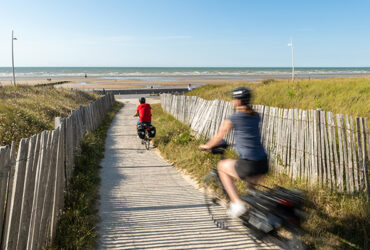
Beyond their exceptional historical significance, the D-Day beaches are a magnificent destination for bike tourism. The coastal roads wind their way between long sandy beaches, chalk cliffs, small fishing ports, and quintessentially Norman villages. Far from traffic, the narrow country roads wind through the Bessin bocage, the Cotentin marshes, and lush countryside dotted with manor houses, stone farmhouses, and centuries-old churches.
By bike, every day offers a new atmosphere. From Bayeux, a remarkable medieval town famous for its tapestry, it’s a pleasant ride to Arromanches-les-Bains and the remains of the Mulberry artificial harbor before continuing on to Gold Beach and Juno Beach. Further west, the route leads to Omaha Beach, the American cemetery at Colleville-sur-Mer, Pointe du Hoc, and then to the vast natural landscapes of Utah Beach and Sainte-Mère-Église, at the gateway to the Cotentin and Bessin Marshes Regional Nature Park.
Travelers wishing to extend their exploration can also tour the Normandy coast over several days. From Saint-Malo and Mont Saint-Michel, a magnificent route leads to the D-Day beaches, following the bay and then the Côte de Nacre. Others choose to continue their journey along the Vélomaritime toward Caen, the Côte Fleurie, or the expansive beaches of the Côte d’Opale.
Whether you’re heading out for a weekend or a full week, the D-Day beaches offer wonderful destinations for cycling. Combining historical heritage, coastal scenery, Norman cuisine, and a commitment to remembrance, each stage blends emotion, discovery, and the joy of cycling in the great outdoors.
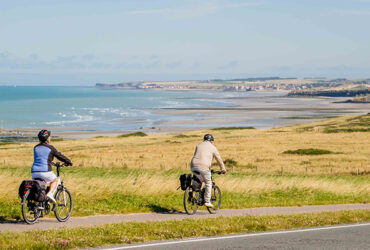
Cycling lets you take your time, allowing you to fully appreciate the diversity of Normandy’s landscapes. You pass through villages that have retained their old-world charm, ride along the cliffs overlooking the English Channel, stop at a forgotten bunker or a military cemetery, and then, a few kilometers further on, enjoy a bustling fishing port or a terrace overlooking the sea. This blend of emotion, nature, and the art of living makes the D-Day beaches a destination particularly well-suited for cycling tours.
A Few Ideas for Cycling Trips Along the D-Day Beaches
The D-Day beaches can be explored just as easily during a short stay as on a week-long or longer cycling tour.
For a first-time visit, a 6-day tour starting from Bayeux lets you explore all the main D-Day sites. After visiting the medieval town and its famous tapestry, the route heads to Arromanches-les-Bains and the remains of the Mulberry artificial harbor, before following the coastline past Gold Beach, Juno Beach, and Omaha Beach. The route then continues to Pointe du Hoc, the American Cemetery at Colleville-sur-Mer, then on to Utah Beach and Sainte-Mère-Église, passing through the unspoiled landscapes of the Cotentin marshes. Each day alternates between small country roads, the Normandy coastline, and visits to the main memorial sites.
For travelers looking to extend their adventure, a 7-day itinerary between Saint-Malo and Bayeux offers a superb journey through Brittany and Normandy. After exploring the ramparts of Saint-Malo and the bay of Mont Saint-Michel, the route gradually winds its way toward the D-Day beaches along the coastline. This trip combines the most beautiful coastal scenery of the English Channel with visits to the major historic sites of D-Day, all while traveling along roads that are particularly pleasant to cycle on.
Lovers of history and the seaside will also enjoy a loop tour around Bayeux, ideal for taking the time to visit the D-Day landing beaches. The route takes you to Port-en-Bessin, Arromanches, Omaha Beach, Gold Beach, and the Côte de Nacre, all while enjoying the gentle Normandy countryside and small fishing ports.
Finally, cyclists wishing to continue exploring Normandy can extend their journey to Honfleur by following the Côte de Nacre and then the Côte Fleurie. After visiting these historic sites, the landscape transitions to seaside resorts, cliffs, the orchards of the Pays d’Auge, and half-timbered houses, offering a route where history, heritage, gastronomy, and coastal scenery blend harmoniously.