The Scandibérique by bike, a great north-south crossing of France
The Scandibérique, a great cycling route to enjoy as you travel through different regions
The Scandibérique is France’s longest cycle route, following a historic north-south traffic and pilgrimage route. Mainly running along small roads with little traffic, it crosses rural areas, river valleys, and towns steeped in history, offering a gradual and coherent overview of the French landscape by bike. In the Loire Valley, its route joins the Loire by Bike in places, combining the rich heritage of the Loire region with particularly accessible routes. This section is an ideal gateway to discover the Scandibérique and get started with cycle touring.

 Leisure
 Easy ,
  Fit
FitDiscover EuroVelo 3 – the Scandibérique
EuroVelo 3, also known as the Pilgrims’ Route, is a major European cycle route linking Scandinavia to Spain. In France, this cycle route is called the Scandibérique and is now the longest signposted cycle route in the country.
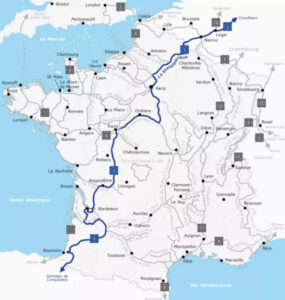
The Scandibérique crosses France from north to south, linking the Hauts-de-France region, passing through the Paris basin, and ending in the Pyrenees. More than just a succession of iconic sites, it offers a long, continuous journey, ideal for discovering France by bike.
The Scandibérique in a few key facts
- A section of EuroVelo 3: the route is part of the European EuroVelo network, linking Trondheim in Norway to Santiago de Compostela in Spain.
- 20 departments and 4 regions to cross: the route passes through Hauts-de-France, Grand Est, Centre-Val de Loire, and Nouvelle-Aquitaine. It crosses cities such as Nevers, Orléans, Tours, and Bordeaux, as well as rural areas rich in natural and architectural heritage, such as the castles of the Loire Valley and the vineyards.
- 72% of the roads are low-traffic: most of the route follows secondary roads or rural paths. For example, in the Loire Valley and the Southwest, you follow country roads with little traffic, making the route peaceful and more suitable for families.
- 23% of cycle paths are dedicated: this corresponds to around 400 km of paths and tracks separated from motor traffic, such as the sections along the Loire à Vélo or certain urban sections in Paris and Bordeaux.
These figures set the tone: a long, coherent route, designed for bike travel and the gradual discovery of territories.
A north-south journey to tailor to your preferences
From the Belgian border, the Scandibérique crosses the Hauts-de-France region before reaching Île-de-France and Paris, a true hub of the national cycling network. Leaving the capital, the route heads towards the Loire Valley, which it follows for a considerable distance between Briare and Tours, before continuing towards Nouvelle-Aquitaine, then the Basque Country, as far as Saint-Jean-Pied-de-Port.
This progression offers a diverse perspective of the French landscape. The initial sections are characterized by canals, rivers, and agricultural plains. Further south, the Loire River shapes the route with its Loire Valley villages and historical sites. The itinerary then becomes more rural, alternating between valleys and small roads, before tackling more pronounced terrain as it approaches the Basque Country.
Types of roads and traffic conditions
The Scandibérique route is primarily developed on low-traffic secondary roads, supplemented by cycle paths where appropriate.
This configuration gives the route an authentic, rural character, much appreciated by cyclists seeking peace and quiet and continuity. Signposting is present along the entire route, making it easy to follow.
The Scandibérique is primarily aimed at cyclists seeking tranquility. It is well-suited for a first cycling trip if the right sections are chosen, and will also appeal to regular cyclists wishing to travel along a major, well-structured route.
A major route connecting and structuring the French cycling network
The Scandibérique occupies a central place in the French cycling network thanks to its numerous connections, allowing for a variety of journeys.
Key routes:
- In Paris: The Véloscénie and the Seine à Vélo (Seine by Bike)
- In the Loire Valley: Shared section with the Loire by Bike between Briare and Tours
- In Bordeaux: Connection with the Canal des 2 Mers à Vélo
Charming secondary routes:
- The Somme Valley in Tergnier
- The Avenue Verte London – Paris between Pont-Sainte-Maxence and Senlis
- The Flow Vélo between Marthon and Châteauneuf-sur-Charente
These connections make the Scandibérique a particularly flexible route, adaptable to different fitness levels, trip durations, or the desire to combine several major cycling routes.
When is the best time to cycle the Scandibérique?
Spring and early autumn are particularly pleasant for cycling the Scandibérique, with moderate temperatures and fewer crowds.
Summer offers long days of cycling, well-suited to the Loire Valley sections and the southwest, while avoiding the peak tourist season.
Winter is more varied depending on the region and is better suited to the southern sections.
The Scandibérique and our cycling holidays in the Loire Valley
At Abicyclette Voyages, the Scandibérique naturally comes to life in our holidays along the Loire River, on one of the most iconic and accessible sections of the route.
From Nevers to Orléans
This route allows you to gradually immerse yourself in the world of the Scandibérique. Starting in Nevers, this 5-day trip takes you along the Loire River in its wildest section, including the Bec d’Allier and the Guétin aqueduct. You’ll pass through Sancerre and its vineyards, then Briare and its aqueduct, before reaching the UNESCO-listed Loire Valley, with its iconic châteaux. The adventure ends in Orléans, the city of Joan of Arc, rich in history and heritage.
From Orléans to Tours
Starting in Orléans, embark on a week-long cycling adventure along the Scandibérique route, following the Loire River and its tributaries to Tours. You’ll discover Blois, Chambord, Amboise, and Chenonceau, passing through villages, castles, and iconic landscapes of the Loire Valley. Each stage offers a gentle immersion in the history, culture, and beauty of the river, along an accessible and leisurely route.