Our cycling holidays in Albania
Explore Albania by bike, a preserved Balkan destination
Discover Albania through cycling trips that reveal a still relatively undiscovered country in the heart of the Balkans.
By bike, you traverse landscapes of dramatic topography against the backdrop of coastlines opening onto the Ionian Sea and the Mediterranean. Cycling allows you to explore this remarkably diverse country: villages, mountains, cities rich in art and history, and historical sites dot the routes, offering a gradual and authentic glimpse into Albania’s culture.
Cycling in Albania is perfect for curious travelers seeking a unique European destination where tranquility and authenticity reign supreme.
 Fit
Fit
 Expert
Albania, Your Next Cycling Holiday
Still relatively unknown on the European cycle touring map, Albania is establishing itself as a unique destination for cycling trips. Located in the Western Balkans, nestled between mountains and Mediterranean panoramas overlooking the Ionian and Adriatic Seas, Albania boasts a remarkable diversity of landscapes within a compact territory. By bike, this configuration allows for rapid changes in scenery without the need for long stretches of road.
Choosing Albania for a cycling trip means embracing a destination that is still relatively unstandardized in terms of tourism. The country wasn’t originally designed for cycle touring, but it lends itself naturally to it thanks to its secondary roads, moderate traffic outside of peak season, and a road network that is now quite user-friendly. This experience is ideal for curious cyclists, already familiar with cycle touring, who are looking for a different kind of European destination, one that is more rugged and rich in both landscape and culture.
Local Life and Gastronomy
Albania bears the marks of a rich history, shaped by Ottoman influences, a long communist period, and then a gradual opening to the rest of Europe. This trajectory is felt in the cities, villages, and daily life. Cycling offers constant contact with the locals. Interactions are simple, often spontaneous, and free from any tourist trappings. The passing cyclists spark curiosity and encourage conversations in cafes, markets, or along the roadsides.
Albanian cuisine is an integral part of this immersive experience. It relies on local products and gives pride of place to meat dishes. Lamb, beef, and poultry are most often grilled or cooked in stews. This hearty and generous cuisine is well-suited to the energy needs of a cycling trip.
It is part of a culinary heritage blending Greek and Turkish influences, while maintaining strong local identities. Each region, sometimes even each village, showcases its specialties. In Gjirokastër, qifqi, rice balls with herbs, are among the traditional recipes. Around Lake Ohrid, koran, an endemic fish, is prepared simply, often grilled. In the Përmet region, gliko, homemade fruit or nut jam, is served as a sign of welcome.
Meals are generally eaten communally. Dishes are placed in the center of the table and shared among the diners. Portions correspond to what has been ordered for the group, and plates are passed around. The tables are often laden with food, and the meal becomes a convivial occasion, reflecting Albanian hospitality.
Discovering Albania by Bike: Roads and Traffic Conditions
Cycling in Albania is primarily done on shared roads. The network consists mainly of paved roads, often secondary, connecting villages, small towns, agricultural areas, and mountainous terrain. Dedicated cycle paths are still underdeveloped, but traffic remains generally light outside of major roads.
In the interior of Albania, roads wind through largely unspoiled rural landscapes with limited traffic, ideal for cycle touring. On the Ionian coast, routes offer panoramic views of the Mediterranean, but traffic increases significantly in summer, particularly in July and August, with the influx of tourists to the seaside resorts. Combined with high temperatures, this traffic makes cycling less comfortable during this period, which we advise against for your cycling trips.
The terrain significantly shapes the routes. Connections between the sea and the mountains include sometimes long climbs that add pace to the stages. The route remains accessible but requires regular cycling practice and good effort management. An electric bike allows you to tackle these hilly terrains with greater ease, without compromising the spirit of the journey.
Albanian Weather and the Best Times for Cycling
Albania has a Mediterranean climate along the coast and a more continental climate in the mountainous regions. Located at the easternmost end of its time zone, Albania directly influences the rhythm of the days: the sun rises early and sets relatively early, especially in spring and autumn. This difference in weather makes early morning cycling trips ideal and encourages adjustments to the itinerary.
Summer, and particularly July and August, is characterized by high temperatures, sometimes difficult to bear on exposed roads, especially along the Albanian Riviera. The heat is accompanied by increased traffic along the coast, making this period less suitable for cycle touring.
The most favorable times are at the beginning and end of the season. From April to June, temperatures are more moderate, the landscapes are still green inland, and road conditions are comfortable. In autumn, from September to October, and until the beginning of November depending on the year, the heat subsides, traffic slows, and the light remains pleasant. These periods offer a good balance between climate, visitor numbers, and the quality of the landscapes.
The 10 Must-Sees in Albania by Bike
- The Albanian Riviera, a spectacular coastline opening onto the Ionian Sea and the Mediterranean, with its rugged terrain, scenic roads, and villages overlooking the sea.
- The Llogara Pass, a natural passage between the mountainous interior and the coast, offering one of the most breathtaking panoramas in the country.
- Gjirokastër, a UNESCO World Heritage Site, remarkable for the preservation of its Ottoman architecture and its hillside location.
- Butrint, a UNESCO World Heritage Site, bearing witness to several ancient periods in a pristine natural environment.
- Berat, a UNESCO World Heritage Site, renowned for its exceptional Ottoman urban fabric and the layout of its historic districts.
- Lake Shkodër, a vast body of water shared with Montenegro, with open landscapes encompassing plains, wetlands, and hills.
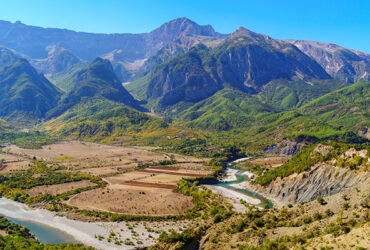
- The Vjosa Valley, one of the last great wild rivers in Europe, flows through largely untouched agricultural and natural landscapes.
- The Albanian Alps, a mountain range in the north of the country, are characterized by deep valleys, isolated villages, and dramatic alpine scenery.
- Tirana, the capital city undergoing rapid transformation, reflects Albania’s recent history and contemporary developments.
- Lake Ohrid, a major natural and cultural site in the Balkans, is shared with North Macedonia and is a UNESCO World Heritage Site.